ObjectConnectorSpringDamper
An simple spring-damper element with additional force, connecting to position-based markers.
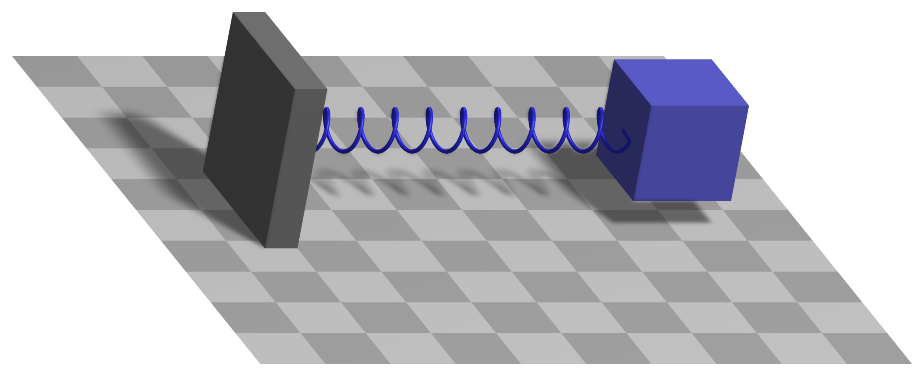
Simpler: mbs.CreateSpringDamper adds this item, with what it needs, in one call.
Interface
Python names:
ObjectConnectorSpringDamperorSpringDamper, andVSpringDamperfor its visualizationMarkers it acts on: those providing
Position: MarkerBodyPosition, MarkerBodyRigid, MarkerNodePosition, MarkerNodeRigid, MarkerSuperElementPosition, MarkerSuperElementRigid, MarkerKinematicTreeRigid
Parameters
The parameters of the item; in a dictionary, its type is ‘ConnectorSpringDamper’:
name |
type |
size |
default |
description |
|---|---|---|---|---|
name |
String |
‘’ |
connector’s unique name |
|
markerNumbers |
ArrayMarkerIndex |
[ invalid (-1), invalid (-1) ] |
(symbol: \([m0,m1]\tp\)) list of markers used in connector |
|
referenceLength |
UReal |
0. |
(symbol: \(L_0\)) reference length [SI:m] of spring |
|
stiffness |
UReal |
0. |
(symbol: \(k\)) stiffness [SI:N/m] of spring; force acts against (length-initialLength) |
|
damping |
UReal |
0. |
(symbol: \(d\)) damping [SI:N/(m s)] of damper; force acts against d/dt(length) |
|
force |
Real |
0. |
(symbol: \(f_{a}\)) added constant force [SI:N] of spring; scalar force; f=1 is equivalent to reducing initialLength by 1/stiffness; f > 0: tension; f < 0: compression; can be used to model actuator force |
|
velocityOffset |
Real |
0. |
(symbol: \(\dot L_0\)) velocity offset [SI:m/s] of damper, being equivalent to time change of reference length |
|
activeConnector |
Bool |
True |
flag, which determines, if the connector is active; used to deactivate (temporarily) a connector or constraint |
|
springForceUserFunction |
ObjectConnectorSpringDamperSpringForceUserFunction |
0 |
(symbol: \(\mathrm{UF} \in \Rcal\)) A Python function which defines the spring force with parameters; the Python function will only be evaluated, if activeConnector is true, otherwise the SpringDamper is inactive; see description below |
|
visualization |
VObjectConnectorSpringDamper |
parameters for visualization of item |
Visualization parameters
The parameters of VObjectConnectorSpringDamper, given as visualization:
name |
type |
size |
default |
description |
|---|---|---|---|---|
show |
Bool |
True |
set true, if item is shown in visualization and false if it is not shown |
|
drawSize |
float |
-1. |
drawing size = diameter of spring; size == -1.f means that default connector size is used |
|
color |
Float4 |
4 |
[-1.,-1.,-1.,-1.] |
RGBA connector color; if R==-1, use default color |
Drawing
Drawn as all connectors; a spring of diameter drawSize between the markers: connectors.springNumberOfWindings windings of connectors.curveTiling segments, lines with connectors.drawSimplified, otherwise a tube.
Settings beyond those of all connectors: connectors.curveTiling, connectors.drawSimplified, connectors.springNumberOfWindings, general.cylinderTiling.
Output variables
Available as OutputVariableType in sensors, Get...Output() and other functions:
output variable |
symbol |
description |
|---|---|---|
Distance |
distance between both points |
|
Displacement |
relative displacement between both points |
|
Velocity |
relative velocity between both points |
|
Force |
\(\fv\) |
3D spring-damper force vector |
ForceLocal |
\(f_{SD}\) |
scalar spring-damper force |
PotentialEnergy |
\(V = \frac{1}{2} k\, (L - L_0)^2 + f_c\, (L - L_0)\) |
elastic energy of the spring and the potential of the constant force; zero if the connector is not active; raises for a springForceUserFunction |
Detailed description
Definition of quantities
intermediate variables |
symbol |
description |
|---|---|---|
marker m0 position |
\(\LU{0}{\pv}_{m0}\) |
current global position which is provided by marker m0 |
marker m1 position |
\(\LU{0}{\pv}_{m1}\) |
|
marker m0 velocity |
\(\LU{0}{\vv}_{m0}\) |
current global velocity which is provided by marker m0 |
marker m1 velocity |
\(\LU{0}{\vv}_{m1}\) |
|
time derivative of distance |
\(\dot L\) |
\(\Delta\! \LU{0}{\vv}\tp \vv_{f}\) |
output variables |
symbol |
formula |
|---|---|---|
Displacement |
\(\Delta\! \LU{0}{\pv}\) |
\(\LU{0}{\pv}_{m1} - \LU{0}{\pv}_{m0}\) |
Velocity |
\(\Delta\! \LU{0}{\vv}\) |
\(\LU{0}{\vv}_{m1} - \LU{0}{\vv}_{m0}\) |
Distance |
\(L\) |
\(\vert\Delta\! \LU{0}{\pv}\vert\) |
Force |
\(\fv\) |
see below |
Connector forces
The unit vector in force direction reads (raises SysError if \(L=0\)),
If activeConnector = True, the scalar spring force is computed as
If the springForceUserFunction \(\mathrm{UF}\) is defined, \(\fv\) instead becomes (\(t\) is current time)
and iN represents the itemNumber (=objectNumber). Note that, if activeConnector = False, \(f_{SD}\) is set to zero.
The vector of the spring-damper force applied at both markers finally reads
The virtual work of the connector force is computed from the virtual displacement
and the virtual work (note the transposed version here, because the resulting generalized forces shall be a column vector),
The generalized (elastic) forces thus result from
and read for the markers \(m0\) and \(m1\),
where \(\Jm_{pos,m1}\) represents the derivative of marker \(m1\) w.r.t. its associated coordinates \(\qv_{m1}\), analogously \(\Jm_{pos,m0}\).
Connector Jacobian
The position-level jacobian for the connector, involving all coordinates associated with markers \(m0\) and \(m1\), follows from
and the velocity level jacobian reads
The sub-Jacobians follow from
in which the term \(\frac{\partial \Jm_{pos,m0}\tp }{\partial \qv_{m0}}\) is computed from a special function provided by markers, that compute the derivative of the marker jacobian times a constant vector, in this case the spring force \(\fv\); this jacobian term is usually less dominant, but is included in the numerical as well as the analytical derivatives, see the general jacobian computation information.
The other term, which is the dominant term, is computed as (dependence of velocity term on position coordinates and \(\dot L_0\) term neglected),
Alternatively (again \(\dot L_0\) term neglected):
Noting that \(\frac{\partial \vv_{f} }{\partial \qv_{m0}} = -\frac{1}{L}\left(\Im - \LU{0}{\vv_{f}} \otimes \LU{0}{\vv_{f}} \right) \LU{0}{\Jm_{pos,m0}}\) and \(\frac{\partial \vv_{f} }{\partial \qv_{m1}} = \frac{1}{L}\left(\Im - \LU{0}{\vv_{f}} \otimes \LU{0}{\vv_{f}} \right) \LU{0}{\Jm_{pos,m1}}\).
The Jacobian w.r.t. velocity coordinates follows as
Note that in case that \(L=0\), the term \(\frac{1}{L} \left(\Im - \LU{0}{\vv_{f}} \otimes \LU{0}{\vv_{f}} \right)\) is replaced by the unit matrix, in order to avoid zero (singular) jacobian; this is a workaround and should only occur in exceptional cases.
The term \(\frac{\partial \Delta\! \LU{0}{\vv}}{\partial \qv_{m0}}\), which is important for large damping, yields
The latter term is currently neglected.
Jacobians for markers \(m1\) and mixed \(m0\)/\(m1\) terms follow analogously.
Userfunction: springForceUserFunction(mbs, t, itemNumber, deltaL, deltaL_t, stiffness, damping, force)
A user function, which computes the spring force depending on time, object variables (deltaL, deltaL_t) and
object parameters (stiffness, damping, force).
The object variables are provided to the function using the current values of the SpringDamper object.
Note that itemNumber represents the index of the object in mbs, which can be used to retrieve additional data from the object through
mbs.GetObjectParameter(itemNumber, ...), see the according description of GetObjectParameter.
arguments / return |
type or size |
description |
|---|---|---|
|
MainSystem |
provides MainSystem mbs to which object belongs |
|
Real |
current time in mbs |
|
Index |
integer number \(i_N\) of the object in mbs, allowing easy access to all object data via mbs.GetObjectParameter(itemNumber, …) |
|
Real |
\(L-L_0\), spring elongation |
|
Real |
\((\dot L - \dot L_0)\), spring velocity, including offset |
|
Real |
copied from object |
|
Real |
copied from object |
|
Real |
copied from object; constant force |
return value |
Real |
scalar value of computed spring force |
Example:
#define nonlinear force
def UFforce(mbs, t, itemNumber, u, v, k, d, F0):
    return k*u + d*v + F0
#markerNumbers taken from mini example
mbs.AddObject(ObjectConnectorSpringDamper(markerNumbers=[m0,m1],
                                          referenceLength = 1,
                                          stiffness = 100, damping = 1,
                                          springForceUserFunction = UFforce))
Mini example
node = mbs.AddNode(NodePoint(referenceCoordinates = [1.05,0,0]))
oMassPoint = mbs.AddObject(MassPoint(nodeNumber = node, mass=1))

m0 = mbs.AddMarker(MarkerBodyPosition(bodyNumber=oGround, localPosition=[0,0,0]))
m1 = mbs.AddMarker(MarkerBodyPosition(bodyNumber=oMassPoint, localPosition=[0,0,0]))

mbs.AddObject(ObjectConnectorSpringDamper(markerNumbers=[m0,m1],
                                          referenceLength = 1, #shorter than initial distance
                                          stiffness = 100,
                                          damping = 1))

#assemble and solve system for default parameters
mbs.Assemble()
mbs.SolveDynamic()

#check result at default integration time
exu.sys['testResult'] = mbs.GetNodeOutput(node, exu.OutputVariableType.Position)[0]
Examples (Ex) and TestModels (TM) that show this item, with weblink to github: basicTutorial2024.py (Ex), tutorialSpringDamperCreate.py (Ex), SpringDamperMassUserFunction.py (Ex), loadUserFunctionTest.py (TM)